
Transportation in net-zero emissions futures: Insights from the EMF-37 model intercomparison study
A new study published in Energy and Climate Change examines how the transportation sector can contribute to achieving economy-wide net-zero CO₂ emissions by 2050.
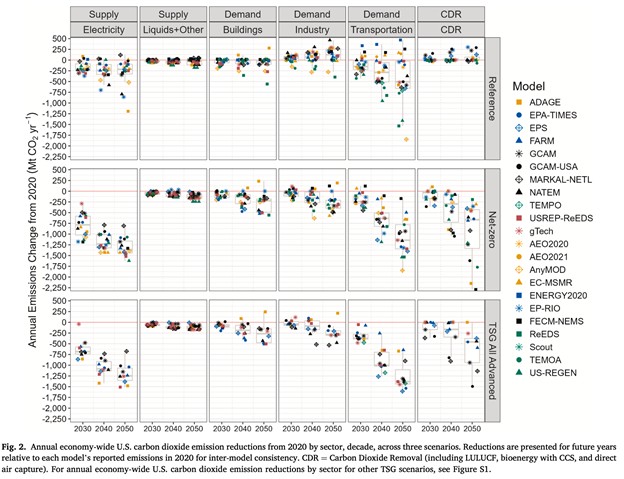
Intercomparing the results from leading energy-economic models in the 37th Stanford Energy Modeling Forum (EMF) project, the research highlights that passenger on-road vehicles are likely to electrify rapidly, while heavier travel modes such as freight, maritime, and aviation will depend on biofuels and hydrogen.
How can the U.S. transportation system decarbonize by 2025? A new multi-model analysis takes on this crucial question, revealing insights into how cars, trucks, ships, and planes might transform in a net-zero future. The study brings together the top US mdoelers to test how different policies, technologies, and behaviors can help the U.S. reach net-zero CO₂ emissions by 2050.
The paper compares results across seven scenarios examining the effects of technology advancement, targeted policies, and behavioral changes. Across all models, passenger road vehicles emerge as the most straightforward to decarbonize, with rapid electrification projected to cut emissions up to 93-100% by 2050. In contrast, heavier transport modes such as freight, aviation, and maritime remain greater challenges, relying on biofuels with limited use of hydrogen. Aviation, in particular, accounts for a larger share of emissions in nearly all scenarios, underscoring the limits of current low-carbon fuel options.
The analysis also highlights a major shift in the transport energy mix. Petroleum use declines substantially while electricity demand grows sharply, ranging from 520 to 1,800 TWh by 2050. The contribution of biofuels and hydrogen varies widely across models, reflecting uncertainties in technology, infrastructure, and policy support. While policies such as zero-emission vehicle mandates and fuel standards can accelerate emission reductions, behavioral changes have a much smaller effect in most models. This limited influence reflects both the car-dependent design of U.S. infrastructure and the current limitation of economy-wide models in representing alternative mobility options.
Even in the most advanced scenarios, residual transport emissions persist, highlighting the need for negative emission technologies to offset the residual emissions.
“The transport sector has traditionally been known as a hard‑to‑abate, high‑emitting source of greenhouse gases,” said Prof. Haewon McJeon of KAIST Graduate School of Green Growth and Sustainability. “This study reports findings indicating that more ambitious reduction targets are attainable. I hope this work will contribute to shaping effective decarbonization strategies across the transport sector.”
This study provides robust evidence that transportation can be a major driver of decarbonization, but also underscores the challenges ahead. The findings highlight both the urgency of scaling EV adoption and the need to accelerate low-carbon solutions for hard-to-abate transport modes.
[paper link]: https://doi.org/10.1016/j.egycc.2025.10021
한글 요약
EMF-37 모델 비교 인사이트: 탄소중립 미래의 수송
수송 분야가 2050년까지 탄소중립 달성에 어떻게 기여할 수 있을까?
최근 Energy and Climate Change에 게재된 본 연구는 이 질문에 답하기 위해 EMF-37의 에너지-경제 모델들을 비교 분석했다. 기술 발전, 정책, 행동 변화를 반영한 시나리오 분석을 통해, 승용차는 전기차로의 전환이 가장 빠르고 확실하게 이루어져 2050년까지 최대 93-100%에 가까운 배출 감축이 가능할 것으로 나타났다. 반면, 화물, 해운, 항공과 같은 중대형 교통 수단은 저감이 더디며, 바이오연료와 수소에 크게 의존하게 되는 것으로 밝혀졌다.
또한 수송 에너지 구조에서도 큰 변화가 예상된다. 석유 사용은 급감하지만 전력 수요는 2050년까지 520~1,800TWh로 크게 증가할 것으로 전망된다. 바이오연료와 수소의 역할은 모델별로 차이가 커, 기술 비용, 인프라, 정책 지원에 따라 결과가 달라질 수 있다. 연구는 전기차 의무판매제나 연비 기준 강화와 같은 정책은 효과적이지만, 대중교통 확대나 차량 이용 감소와 같은 행동 변화는 상대적으로 영향이 제한적이라고 분석했다.
KAIST 녹색성장지속가능대학원의 믹전해원 교수는 “이번 연구를 통해 탄소배출 비중이 크고 감축이 어렵다고 알려진 수송 분야에서도 더욱 향상된 배출량 감축 목표 달성이가능함을 보여주었다”라고 말했다.