
Models & Projects
KAIST IAM Group
Models & Projects
Our group develops and applies integrated assessment and energy system models to explore decarbonization pathways, climate policy, and sustainability transitions. We also contribute to collaborative research projects that connect modeling innovation with real-world policy decision support.
Models
GCAM-core
GCAM-core is an open-source integrated assessment model developed by the Joint Global Change Research Institute (JGCRI). It represents interactions among energy, water, land, economy, and climate systems, and is widely used for long-term scenario analysis of global change mitigation and adaptation.
GCAM-KAIST
GCAM-KAIST is the KAIST IAM Group’s customized modeling framework based on GCAM. Our work focuses on improving the model’s relevance for Korea and globally connected systems by incorporating country-specific assumptions, sectoral detail, and policy-relevant scenario design for sustainability and net-zero analysis.
Projects
Net-Zero Korea (NZK)
Accelerating Energy and Industrial Decarbonization
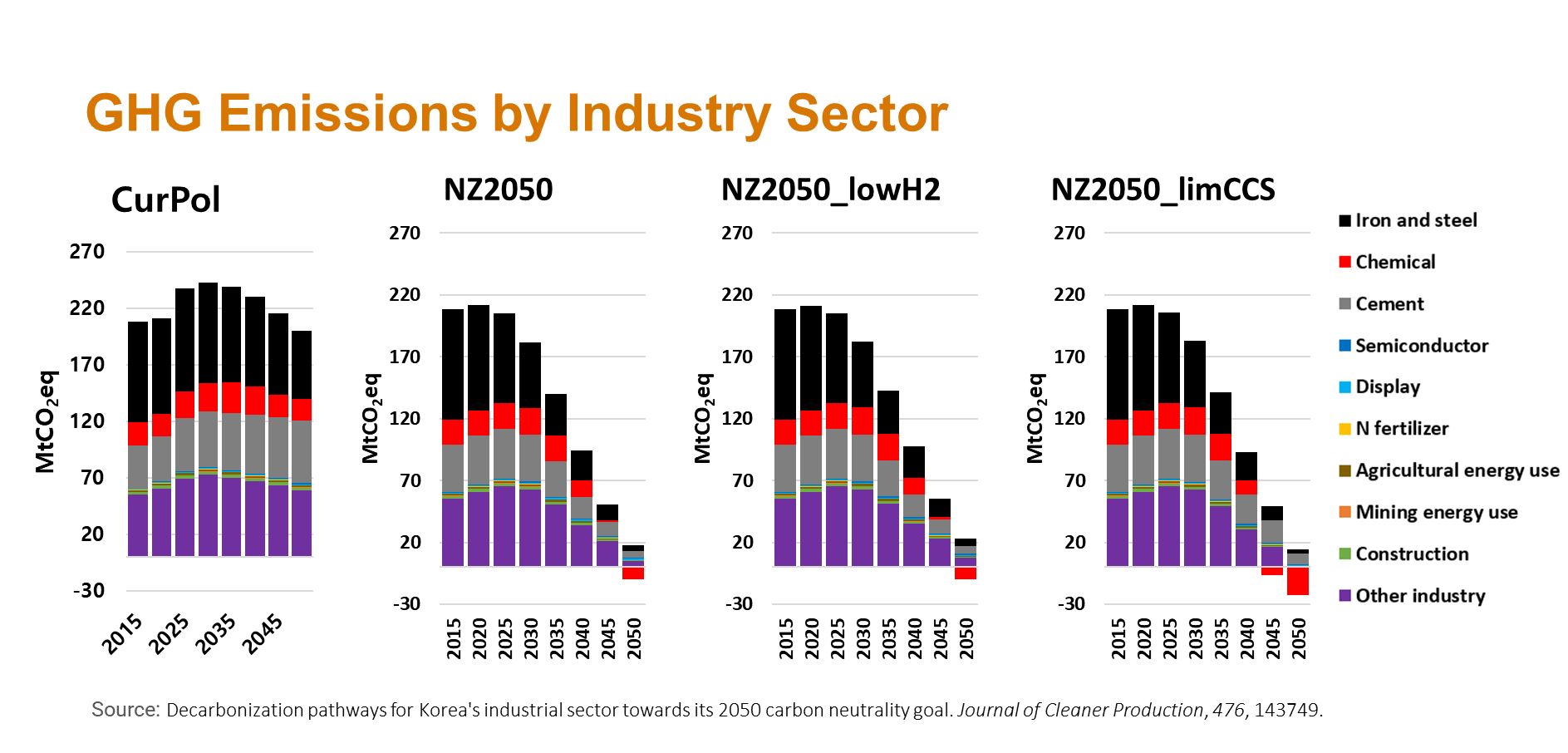
The Net-Zero Korea (NZK) project is a landmark collaboration between the KAIST Graduate School of Green Growth and Sustainability and the Andlinger Center for Energy and the Environment at Princeton University. Supported by seed funding from Google, the initiative aims to accelerate the Republic of Korea’s energy and industrial decarbonization through high-resolution modeling and policy decision support.
Collaborative Modeling Innovation
NZK adapts the pioneering modeling approach introduced in Princeton’s Net-Zero America study, bringing greater granularity to the Korean context, including local land use, capital investment requirements, employment shifts, and air pollution health impacts.
Institutional Strengths
- Princeton expertise: high-resolution modeling frameworks for national and subnational planning.
- KAIST expertise: deep knowledge of the Korean socio-economic context, international trade, and global supply chains.
Project Goals
- Inform decision-making: create effective, data-driven tools to guide Korea’s sustainable energy and industrial future.
- Global scalability: develop modeling capabilities for trade-exposed economies with strong global supply chain integration.
- Achieve net zero: support broader net-zero efforts through rigorous scientific analysis and multi-sectoral collaboration.
Geophysics-Human Interaction Model (GHIM)
AI-Based Next-Generation Integrated Assessment Modeling
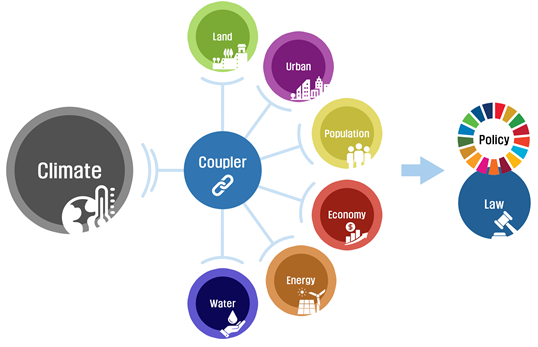
In collaboration with MetaEarth Lab, the GHIM project aims to advance the Integrated Assessment Modeling (IAM) paradigm by developing a next-generation framework that explicitly simulates bidirectional feedbacks between the Earth system and human society. By leveraging AI and machine learning, the project addresses limitations of traditional one-way climate impact assessments.
Key Innovations & Framework
- Bidirectional interaction: simulating how socio-economic responses such as policy, migration, and trade feed back into the climate system.
- AI-enhanced sector models: resolving high-resolution complexity in water, food, energy, and urban systems.
- Comprehensive socio-economic analysis: incorporating demographic change, legal frameworks, and financial risk.
Our Objectives
- Technological leadership: develop IAM capabilities that strengthen climate research and policy support.
- Granular policy support: provide detailed analysis for water, food, and energy security.
- International contribution: contribute high-quality data to intercomparison exercises and IPCC-related efforts.
NEWPATHWAYS
Advancing Global and National Low-Emission Pathways
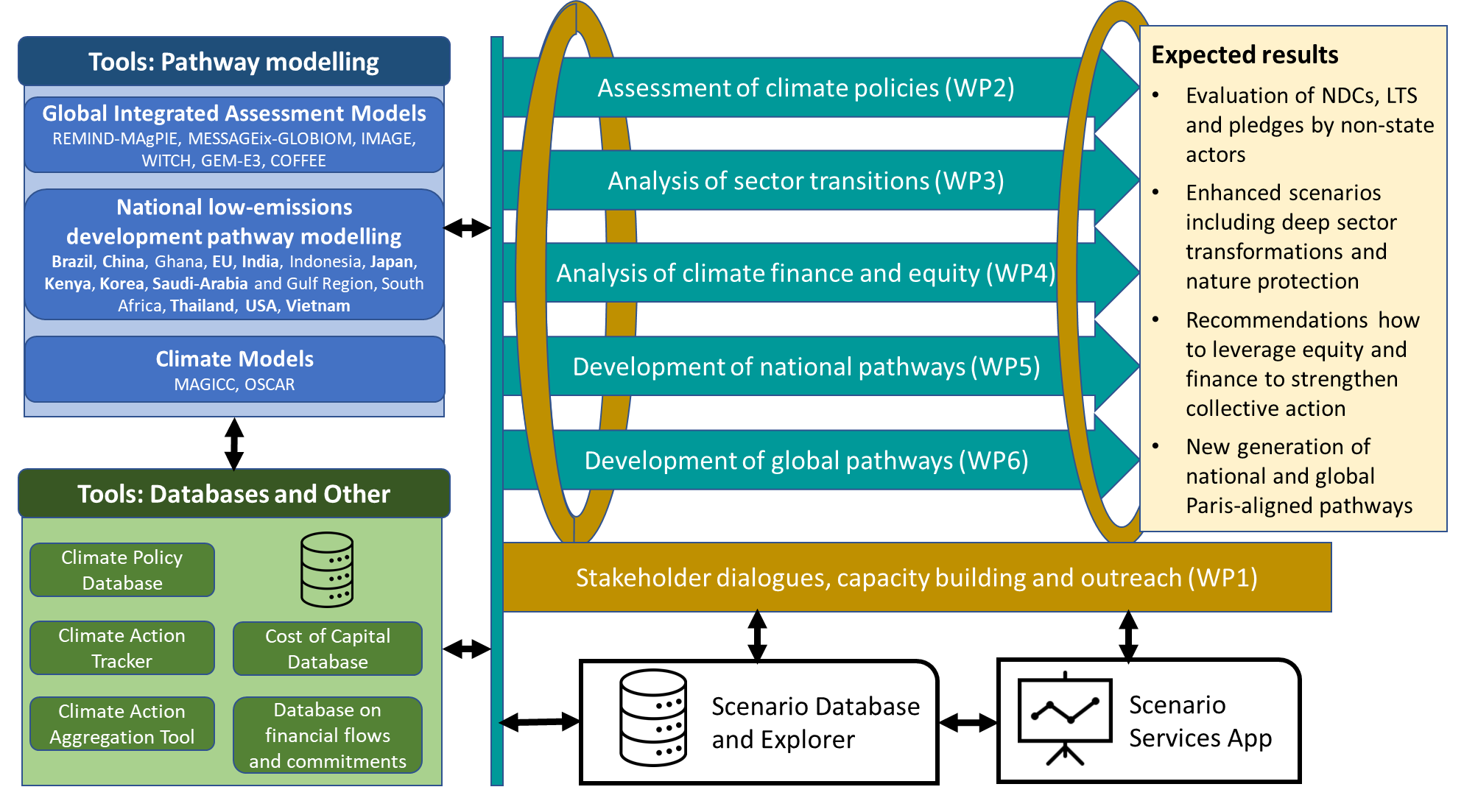
The KAIST IAM Group joined the NEWPATHWAYS project as an associate partner representing the Korean modeling team. Funded through the EU Horizon program, this 42-month initiative brings together 24 partner organizations across 18 countries to define next-generation transformation strategies for a sustainable future.
Our Mission within NEWPATHWAYS
The project aims to develop a scientific and socio-economic roadmap to limit global warming to well below 2 K, with a primary target of 1.5 K. By integrating advanced modeling with social science and economic perspectives, NEWPATHWAYS supports a sustainable, equitable, and just transition.
As an associate partner, the KAIST IAM Group contributes a critical South Korean perspective, helping ensure that global pathways are grounded in regional realities, transparency, and equity.
Key Research Objectives
- Next-generation modeling: establish transformation pathways that minimize temperature overshoot while protecting biodiversity and nature.
- Accountability & transparency: improve the clarity and consistency of GHG reduction commitments across governance levels.
- Equity and finance: identify opportunities to leverage international finance and equity principles for stronger climate action.
Learn more: NEWPATHWAYS
Coal Power Plant Repowering in Korea
Linking Site-Level Repowering Decisions to National and Global Pathways
Supported by a grant from the Repower Initiative, this project examines how repowering existing coal-fired power plants could contribute to Korea’s energy transition and to global decarbonization pathways. Led by KAIST professors Son H. Kim, Haewon C. McJeon, and Jeong Ik Lee, the work uses the Global Change Analysis Model (GCAM) to place plant-level decisions within long-term energy, emissions, and socio-economic scenarios.
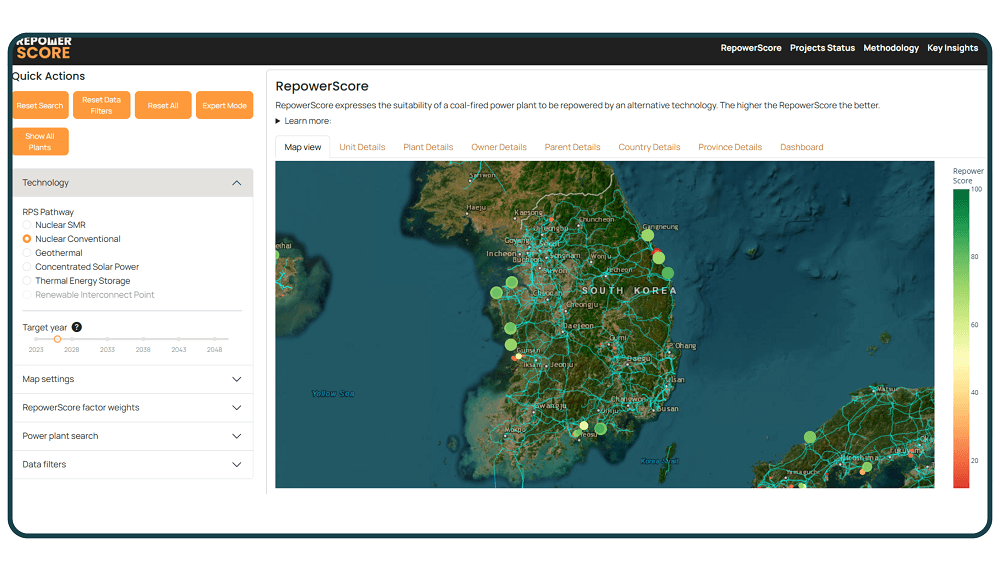
Modeling Individual Power Units
The team is extending GCAM-KAIST to represent Korea’s coal-fired units individually rather than as a single aggregate capacity figure. Each site differs in capacity, grid connection, remaining lifetime, water and resource characteristics, emissions profile, and local economic role, and this granularity allows repowering pathways to be evaluated against emissions, energy supply, grid reliability, replacement timelines, policy costs, and regional outcomes.
Why Korea
- Scale of the fleet: roughly 39 GW of coal capacity, supplying close to a third of national electricity.
- Binding targets: a commitment to net-zero greenhouse gas emissions by 2050.
- Structural constraints: limited land availability, an energy-intensive economy, and rising demand from electrification and AI data centres, all of which make reuse of existing plant sites strategically valuable.
Project Stages
- Korea focus: model calibration and discrete unit representation, scenario generation spanning baseline, technology policy, repowering, coal-to-nuclear, and net-zero cases, with interim and technical reporting.
- Beyond Korea: sensitivity analysis, site suitability assessment using RepowerScore, evaluation of local impacts, and extension to China-based and global scenarios including temperature response.
Learn more: Repower Initiative